Friday, July 31, 2015

Blog #3 - Carlisle Indian Industrial School


"From 1879 until 1918, over 10,000 Native American children from 140 tribes attended Carlisle. Only 158 graduated."
(“Carlisle Indian Industrial School,” 2015)
 
For my third blog posting I decided to review the Wikipedia page about the Carlisle Indian Industrial School.  The school was located in Carlisle, Pennsylvania and was in existence from 1879 to 1918.  At this time in American history many people thought that Native American children needed let go of their Native American cultures and assimilate to the white culture in America.  The Carlisle Indian Industrial School was a boarding school far from their reservations where the Native American children could be taught new skills that could help them “mainstream” and find employment.  Unfortunately, as soon as the children arrived at the school they lost parts of their culture and identities.  Upon arrival their hair was cut and their names were changed to non-Native American names.  Apparently, there were even incidents of violence against the children who had more difficulty with assimilating during their time at the school.  The Carlisle Indian Industrial School saw over ten thousand students enter its doors, however, only 158 students actually graduated.  During their time at the school students were given the task of learning English.  The children also had to stop wearing Native American style clothes and were forced to wear clothes that non-natives typically wore.  The children were subjected to strict discipline at Carlisle.  During the summer the school had the students work as domestic servants or farm workers at homes in the area.  Overall, it was very interesting to learn about the Carlisle school, even though it is a sad part of American history.  I highly recommend the article for anyone who is interested in the subject (“Carlisle Indian Industrial School,” 2015). 
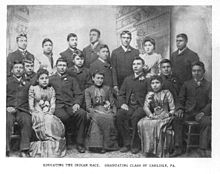
 
"Between 1899 and 1904, Carlisle issued thirty to forty-five degrees a year. "Educating the Indian Race. Graduating Class of Carlisle, PA." ca. 1890s"
(“Carlisle Indian Industrial School,” 2015)


Works Cited

“Carlisle Indian Industrial School.” Wikipedia.org. 22 June 2015. Web. 1 August 2015.

The Three Affiliated Tribes v. Wold


For this blog I selected the M3 on line resource of “Tribal Courts of New York.”1 The selection was in part due to the embedded link that redirected me to the Three Affiliated Tribes and the case against Wold Engineering in the US Supreme Court. My scholarly project was that of the Hidatsa Indian Tribe and the Three Affiliated Tribes. This was a natural segway into this blog as they tie nicely together.

My main concern with this story is the jurisdictional issues between tribal, local, state and federal courts. [This case was in regards to Wold Engineering installing a water supply system on the Fort Berthold Indian Reservation that was determined by the Three Affiliated Tribes to be inadequate. The Tribe was suing Wold Engineering for breach of contract and negligence. The issue with this case is that the state failed to hear the case on the basis that Indian territories were generally deemed beyond the legislative and judicial jurisdiction of the state governments. Therefore the case was dismissed by the North Dakota Supreme Court on the basis of “lack of jurisdiction.” The reason being is that The Three Affiliated Tribes could not avail itself of state court jurisdiction unless it consented to waive its sovereign immunity and to have any civil disputes in state court to which it is a party adjudicated under state law. In other words, they had to relinquish their sovereignty to gain access to the US Court Systems. This naturally presented many conflicts of interest hence the reason that it went to the Supreme Court of the United States to be litigated. Without access to the US Court System, the Tribe would have no affective means to litigate civil matters nor would it have the ability to enforce judgments and or settlements. North Dakota upholds their position that the tribe was not deprived of access to the court because they could have elected to consent to statutory conditions. However, those statutory conditions may be met only at an unacceptably high price to tribal sovereignty, and thus operate to effectively bar the Tribe from the courts. The conclusion is that the operation of the North Dakota jurisdictional scheme in this case is inconsistent with federal law and is reinforced by the fact that it imposes an undue burden on federal and tribal interests in Indian self-government and autonomy, as well as the federal interest in ensuring access to the courts]2

I believe this material was carefully considered for this course due to the issues regarding sovereignty and the consistent practice to reduce or diminish tribal sovereignty. This was evident in the position of the North Dakota Supreme Court. The information contained within these resources continues to exemplify the constant battle the tribes must fight to establish their rights and protections as sovereign nations. Although the Natives are making slow progress, it comes with a heavy mental and financial toll. 


1.       Empire State College, First Peoples of North America, Reservation to Resurgence Wks. 9-11, M3 Online Resources, Tribal Courts of New York, New York Federal-State-Tribal Courts and Indian Nations Justice Forum, Internet, Accessed 07-30-15, http://www.nyfedstatetribalcourtsforum.org/history.shtml


2.       Justia US Supreme Court, Affiliated Tribes v. Wold Engineering, Internet, Accessed 07-30-15, https://supreme.justia.com/cases/federal/us/476/877/case.html


Monday, July 27, 2015

I found the different tribal newspapers fascinating and very inspirational. It was nice to see that the tribes are putting forth their own news and their opinions of news that is affecting their own people. One article that I found especially interesting was in the Native American Times about a man in South Dakota that was arrested for harassing Native American children with racial slurs and spitting beer on them. Native American took the matter into their own hands when they felt that the sentencing was considered too lenient. This demonstrates the problems that are still being faces by many Native Americans and the racism that they face. It also shows how the Native Americans are still very loyal to their own people and want to see justice for their own when they are wronged.
This man was not given any jail time and was given a very small fine for the injustice that he did against these people. They held their own trial where more than 100 of their people came to discuss the injustice and the racism that exists in their city since this was not the first time this sort of racism had occurred. Many felt that there is a double standard of justice in the city. There seems to be an ongoing tension between Native American and the law enforcement in Rapid City
Problems for the Native Americans still goes on and they still fight for equal rights today.

Trial begins of man accused of harassing Indian kids

  •  
 Parent Category: News
 Published on Friday, 24 July 2015 16:54
 Written by JAMES NORD, Associated Press

It is really worth read....
Anthony Congdon
Anhony Congdon

I found the different tribal newspapers fascinating and very inspirational. It was nice to see that the tribes are putting forth their own news and their opinions of news that is affecting their own people. One article that I found especially interesting was in the Native American Times about a man in South Dakota that was arrested for harassing Native American children with racial slurs and spitting beer on them. Native American took the matter into their own hands when they felt that the sentencing was considered too lenient. This demonstrates the problems that are still being faces by many Native Americans and the racism that they face. It also shows how the Native Americans are still very loyal to their own people and want to see justice for their own when they are wronged.
This man was not given any jail time and was given a very small fine for the injustice that he did against these people. They held their own trial where more than 100 of their people came to discuss the injustice and the racism that exists in their city since this was not the first time this sort of racism had occurred. Many felt that there is a double standard of justice in the city. There seems to be an ongoing tension between Native American and the law enforcement in Rapid City
Problems for the Native Americans still goes on and they still fight for equal rights today.

Trial begins of man accused of harassing Indian kids

  •  
 Parent Category: News
 Published on Friday, 24 July 2015 16:54
 Written by JAMES NORD, Associated Press

It is really worth read....

Module 3 Blog


Module 3 Academic Journal Blog

By: James Berrigan


For this Academic Blog I read about and chose to Blog about the Carlisle Indian Industrial Schools that were operating in the United States from 1879 – 1918.  For those that do not know, “Carlisle was the first federally funded off-reservation Indian boarding school” (1).  While that fact may not be up for debate, depending on who you ask, the intention or purpose of the school could be.  However, the intention of this post is not to spark another discussion as to the effects of the school or the cultural ramifications of Carlisle.  The intention of this Blog is to simply explain my opinion of Carlisle Indian Industrial School.

When reading the article in Wikipedia about Carlisle Indian School there was one point I wanted to discuss.  As mentioned above, depending on who you ask, the opinions of Carlisle Indian Industrial School vary.  The Web Resource for Module 3 that I have cited, states that Carlisle “was founded on the principle that Native Americans were the equals of European-Americans, and that Native American children immersed in mainstream Euro-American culture would learn skills to advance in society” (1). 

It is my opinion, based on the cited quote and the timeframe that Carlisle was operating, Carlisle was founded to and should have been much more beneficial to the Native Americans involved.  Carlisle was operating at the same time that the United States was going through their historic Industrial Revolution and people with Vocational skills were in great need and valued in the work place.  However, I feel that the way in which Carlisle placed process over education and the way they attempted to assimilate Native Americans into the modern world was obviously flawed.  Should the school have focused on providing the involved parties with the skills needed to succeed in a rapidly changing world in lieu of “killing the Indian to save the man” (1), Carlisle could have been an essential tool or aid for Native Americans.

It was said that while some 10,000 Native Americans from 140 tribes attended Carlisle, only 158 graduated (1).  To put that into modern day numbers, in New York State, roughly 75% of eligible students graduated High School in 2013 (2).  Carlisle had a graduation rate of approximately 1.6% which would be beyond unacceptable at any school level in modern times in the United States. 

As you know, the intention of this Blog was not to argue the cultural ramifications of Carlisle but was to just explain my opinion.  It is my opinion that Carlisle was founded with good intentions.  However, somewhere along it transformed.  Unfortunately, Carlisle missed an amazing opportunity that could have positively influenced the Native American culture in a way that, if done correctly, this course we are taking would be drastically different.  If done correctly, Carlisle Indian Industrial School, could been known for providing an environment of growth and opportunity for the Native American culture which aided in continuing Native American traditions while assimilating Native Americans to the modern world instead of further crippling Native Americans and being yet another blunder made by the US Government in regards to Native American relations.


Works Cited

  1. Carlisle Indian Industrial School:  From Wikipedia, the free encyclopedia:
  2. The Wall Street Journal:  By Leslie Brody.  June 23, 2014
    http://www.wsj.com/articles/new-york-high-school-graduation-rates-inch-up-1403572053


Monday, July 20, 2015

Module 2 Blog


Module 2 Blog Post

By: James Berrigan


For the Module 2 Blog Post I selected to watch “In the Light of Reverence”.  This is a PBS sponsored film and the film description is “is a 72-minute documentary on Native American struggles to protect landscapes of spiritual significance”.  Specifically, this short film describes the struggles of three Native American Tribes, the Wintu, Lakota and Hopi, and their struggles relating to their continued land loss both on public and private land. 
 

I really like this film as it provides both sides of a particular debate in real time.  The film showed both Native Americans and Non Native Americans perspective, sometimes back to back, throughout the film allowing the viewer to absorb both sides instantaneously as opposed to hearing one person or groups perspective in full then hearing an opposing view.  I believe this method used by the film makers to be much more effective.  When I finished watching the video I went back and watched the beginning sections about the Lakota people and their spiritual/religious connection to the Black Hills in Wyoming.  For some reason I was intrigued by comments made by the non-Lakota people in regards to not understanding how the Lakota could have a spiritual/religious connection to land and how their own beliefs clouded their judgment and reasoning when interpreting the wishes of the Lakota.  It was stated around the fifteen minute mark that religious observations outside of a formal structure like a church, are considered “recreation”.  Again, around the Nineteen minutes and forty five second mark a comment was made about how the Lakota’s connection to the land has no similarities to church at all. 


I find these comments to be completely ridiculous and rather ignorant and am embarrassed for the people that chose to voice such ludicrous words.  Personally, I am an avid outdoorsman and can attest the spiritual/religious awakening I receive every time I am in some of my most favorite areas of the Adirondack Mountains.  Additionally, I was raised in a very religious family and can honestly say that I have never had that same feeling in church.   More so now than ever, I feel the sadness, while not to the point of the native peoples of the short film, shared by the indigenous.  I recently relocated from my home in Upstate New York to northern Texas.  Having only been a little more than a week, I can already tell/feel that I will need to find a similar release in my new home.


Unlike the Lakota or any other tribal group who were robbed of their sacred land, I have no immediate ties or ownership to these areas of the Adirondack Mountains that provided me with the aforementioned religious like experiences.   Much if not all of the property in New York I explore is open to the public.  However, it does sicken me when people to do not respect the land in which I so greatly appreciate and utilize as my form of religion or church.  As such, I cannot imagine the feeling of blatant disrespect felt by the Lakota and other tribes mentioned in the film. 
 

I voluntarily relinquished my spiritual place for my career with hopes that I one day can return indefinitely.  While I will have intermittent spurts of being back in the mountains I love and need so much, as mentioned above, it will not be enough and am longing to find a similar connection in my new home.  Again, I do not know what I would do if forcefully removed from or had to bear witness to someone or group of people disrespecting my sacred place.


While I understand nature is not for everyone and for those who do not or cannot understand the spiritual connection between humans and nature keep in mind that some of us feel the same way about your beliefs.  However, we all need to be accepting, understanding and tolerant of what our fellow humans consider sacred and holy.

Wednesday, July 8, 2015

http://www.history.com/topics/native-american-history/native-american-cultures

This is an excellent website from the History channel that shows and explains the cultures of Native Americans from each region in America with some very interesting videos. I especially enjoyed and was amazed by the video on the buffalo and the many uses for it. I hope you find this site as interesting as I did.

Monday, July 6, 2015

Second Post - National Museum of the American Indian


For my second blog post I decided to review the National Museum of the American Indian website.  I was fortunate enough to visit this museum last time I was in New York City, and it was an amazing experience that I would highly recommend to others.  There were fascinating exhibits on Native American art, culture, and jewelry.  The website details their collection as, “Overall, 55 percent of the collection is archaeological, 43 percent ethnographic, and 2 percent modern and contemporary arts” (National Museum of the American Indian, 2015).   


 (Shoshone leggings and moccasins, National Museum of the American Indian, 2015)

The museum has a plains collection, plateau collection, and southwest coast collection, among many others.  The collections originated with George Heye, who starting purchasing pieces in 1897.  His first purchase was a Navajo hide shirt in Arizona and the collection continued to expand.  His collection grew to over 10,000 pieces by the year 1906.  On the website you can search through the collections by peoples, places, and artists.  One aspect of the website that I felt was very interesting is that there is a section about repatriation, which means that some of the items in the museum might be returned to the families and/or tribes where they came from.  “Human remains, funerary objects, sacred objects, and objects of cultural patrimony are all materials that may be considered for repatriation” (National Museum of the American Indian, 2015).  I think it is important to display the art and ethnographic objects, however, I am happy that there is also a way for tribes and families to get sacred objects back (National Museum of the American Indian, 2015).
 
photo archives 
(Herding the Sheep, Harrison Begay, Navajo painting, National Museum of the American Indian, 2015)

Work Cited:
Smithsonian. National Museum of the American Indian. 2015. Web. 6 July 2015.

Thursday, July 2, 2015

M3 - Tribal Courts of New York

The source I chose to review is Tribal Courts of New York; Judge Marcy L. Kahn, Judge Edward M. Davidowitz and Joy Beane created it. I thought this was great information sources discussing the history of how the New York Tribal Courts Committee and the New York Federal State Tribal Courts Forum originated. It also discusses how the Committee meets to talk about current issues the Tribes have and how they can solve them. The author’s state, “the idea of creating forum to address and to resolve jurisdictional conflict.” (Kahn, Davidowitz, and Beane, pgs. 10-12) I think the source is meant to provide information the constant fight the Native’s have to get the freedom they deserve.

I think many of these resources are chosen for this course because they deal directly about what we are studying. We are discussing Native American issues in this Module and the sources provide an abundance of information about different issues.  I chose this source because it talked about issues in the state I live in and the information written by some of the committee members who deal directly with Committee and Forum, which is reliable. The authors state, “ the Planning Group proposed an educational session at which tribal representatives could meet with federal and state judges to discuss key issues” (Kahn, Davidowitz, and Beane, pgs. 10-12)

The information I have read has gave me more information and background on the surrounding issues dealing with the Natives. I have been view an abundance of information dealing with tribes from the Northeast region. I believe reading about different time periods of native communities, it has given me more a sense of what they have endured and the constant fight they have to resolve issues that they have been persecuted for.  This has definitely changed my view about how the U.S. government has treated the Natives. One issue that really has been at the forefront of the Native issues is educating court judge on Indian government and culture. The authors state, “ the need to educate and train state court judges in Indian government and culture.” (Kahn, Davidowitz, and Beane, pgs. 10-12)


Kahn, Marcy, Edward Davidowitz, and Joy Beane. "History." New York Federal-State-Tribal Courts And Indian Nations Justice Forum. N.p., n.d. Web. 21 July 2015.

http://www.nyfedstatetribalcourtsforum.org/history.shtml